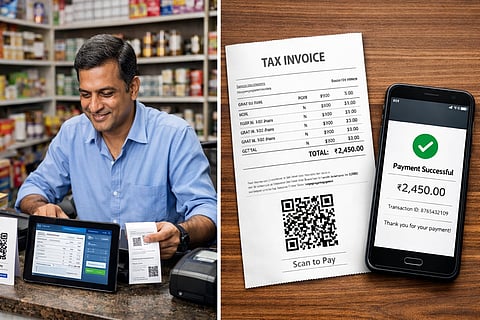

For decades, India’s retail shops functioned on trust, handwritten ledgers, and carbon-copy bill books. The neighbourhood kirana store owner knew the customer's preferences by memory. A garment retailer tracked stock mentally. Transactions were quick, personal, and deeply human. Billing was a routine task - simple, familiar, and rarely questioned.
But as GST formalised taxation and digital payments reshaped consumer behaviour, retailers began moving toward structured systems such as modern billing software for retail shops to generate compliant invoices, automate tax calculations, and maintain real-time inventory records without slowing down daily operations. What started as a compliance adjustment has quietly evolved into a broader operational shift.
Across India - from metropolitan supermarkets to small-town provision stores - the retail counter is no longer just a place where transactions happen. It is becoming a control centre where billing, inventory, payments, and reporting converge into one streamlined system.
Traditional billing methods rely heavily on paper records. While simple, they introduce friction over time. Manual tax calculations can result in errors. Searching for old invoices during returns becomes time-consuming. Stock mismatches occur because inventory updates are delayed or forgotten.
In isolation, each issue seems manageable. Together, they create inefficiencies that compound daily.
Retailers are realising that billing is not merely about printing receipts. It is the operational backbone of the business. Every invoice affects accounting accuracy. Every stock entry influences purchasing decisions. Every payment record impacts cash flow visibility.
When billing becomes structured, clarity follows.
The introduction of the Goods and Services Tax was a turning point. Compliance requirements meant retailers needed accurate tax calculations, proper documentation, and accessible records.
For businesses accustomed to handwritten bills, this represented a structural shift. Accountants required cleaner data. Audits required traceability. Errors carried financial consequences.
Digital systems simplified this process by automating tax calculations and generating GST-compliant invoices. Instead of manually computing percentages, retailers could rely on built-in logic. Instead of storing stacks of paper, they could retrieve invoices instantly.
Compliance moved from stress to structure.
UPI adoption further accelerated change. Customers increasingly prefer scanning a QR code and completing payment instantly. Printed invoices now often include embedded QR codes that reflect the exact transaction amount.
This reduces confusion, speeds up checkout, and improves accuracy.
A billing system integrated with digital payments eliminates mismatches between billed amounts and received payments. For retailers managing hundreds of daily transactions, this precision matters.
This transformation is not being driven by large enterprise ERP platforms. Instead, it is powered by tools built specifically for India’s small and medium retailers.
In recent years, several niche platforms have emerged to serve this segment. Solutions such as myBillBook, Retail Daddy, Go GST, etc., focus on simplifying GST billing, inventory tracking, and everyday accounting for neighbourhood stores without adding unnecessary operational complexity.
Rather than overwhelming retailers with enterprise features, these systems prioritise speed, clarity, and ease of use. Many are mobile-first, allowing shop owners to manage billing, stock, and compliance directly from their phones.
One of the most overlooked benefits of digitization is the way billing and checkout systems now work together. Retailers increasingly rely on integrated setups that combine invoicing, inventory, and payment tracking within unified POS billing software, reducing manual entries and minimizing billing errors during peak hours.
Inventory management becomes proactive instead of reactive. Low-stock alerts prevent sudden shortages. Sales reports highlight underperforming products. Purchase planning becomes data-driven rather than instinct-based.
What was once available only to large retail chains is now accessible to small independent stores.
Tools designed specifically for small and medium retailers have made this shift practical. For example, purpose-built billing software for retail shops enables shop owners to generate invoices, manage inventory, track payments, and share reports with accountants - all from a single system designed for day-to-day retail operations.
The learning curve is often shorter than expected because these systems prioritize usability. Many are mobile-friendly, enabling retailers to manage business functions without needing advanced technical skills.
Digitization does not remove the human element from retail. It reinforces it.
When billing is accurate and transparent, customers feel confident. When old invoices can be retrieved instantly during exchanges or returns, service improves. When checkout is faster, queues shorten.
The relationship between shopkeeper and customer remains central. Technology simply supports it.
Trust, once built purely on familiarity, is now reinforced by structured documentation.
Manual systems create blind spots. Outstanding payments may go unnoticed. Stock discrepancies may remain undetected. Seasonal trends may not be clearly visible.
Digital billing reduces these uncertainties.
Daily sales summaries provide immediate insight into performance. Payment tracking highlights pending dues. Tax reports simplify monthly filings. Business owners gain visibility into cash flow and profitability.
Clarity reduces risk.
Retail is part of a larger movement within India’s micro, small, and medium enterprises. Across sectors, businesses are moving from informal processes to structured digital systems.
Manufacturers are automating invoicing. Distributors are managing credit cycles digitally. Service providers are generating standardized bills.
This transition is not about replacing traditional businesses. It is about strengthening them with infrastructure.
Digital systems provide continuity. Even if physical records are misplaced, data remains accessible. Even if management transitions between generations, historical records remain intact.
This is particularly important as younger entrepreneurs increasingly step into family-run businesses and prioritize efficiency.
India’s retail environment is evolving rapidly. Organized retail and online marketplaces continue expanding. Consumers expect consistency and speed.
In such an environment, operational discipline becomes a competitive advantage.
Retailers who can monitor stock in real time, issue compliant invoices instantly, and analyze sales trends hold an advantage over those relying solely on manual methods.
The shift is not about adopting technology for its own sake. It is about creating systems that support sustainable growth.
The retail counter is no longer just a transaction point. It is a control centre.
The ledger is becoming searchable. The invoice is becoming intelligent. The bill is becoming a data source.
And this transformation is unfolding quietly across thousands of shops in India.
Small retailers are not abandoning tradition. They are strengthening it with structure. The entrepreneurial instinct remains as sharp as ever. What has changed is the infrastructure supporting it.
In the coming years, the success of retail businesses may depend less on store size and more on operational clarity.
The digital shift has begun. It is happening one invoice at a time.

