
A museum can hold thousands of objects and still leave its visitors with very little understanding of the world that produced them. A sculpture, a coin, a manuscript or a piece of jewellery becomes meaningful when someone explains where it came from, who made it, how it travelled, what it was used for and why it matters. The object is the evidence. The story gives it context.
That distinction will matter enormously at the Yuge Yugeen Bharat National Museum.
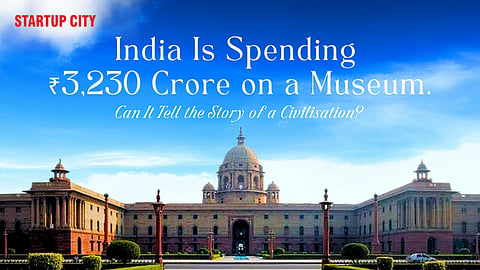
The Union Cabinet's approval of the ₹3,230-crore project on November 11 has moved the proposed museum closer to implementation. North and South Block in New Delhi will be adapted into a public cultural institution, with the government identifying approximately 1.8 million objects across the National Museum, other Ministry of Culture museums, 52 Archaeological Survey of India site museums, state museums and private collections for the project.
The proposed themes are expansive: architecture and cityscapes, mathematics and astronomy, languages and scripts, faith and spirituality, and India's historic connections through trade and ideas. The first gallery, titled Adornment, is expected to open in North Block in the latter part of 2027. The wider project is scheduled to be developed in phases through FY 2030-31.
These are substantial ambitions. They also point to a challenge that cannot be resolved through construction, technology or the number of galleries alone. The museum must decide how to select, interpret and connect the material evidence of a country whose history has never followed a single route.
The figure of 1.8 million identified objects is striking, but it needs to be understood in context. These objects come from institutions and collections spread across the country. They belong to different periods, communities, artistic traditions and systems of knowledge. Some are already familiar to museum visitors; others may be less widely documented or displayed.
Identifying an object for a museum is only the beginning of the process. Curators must establish its provenance, assess its condition, understand its historical context and determine what it can contribute to a gallery. They must also decide how it should be displayed, what should accompany it and which other objects might help visitors understand its significance.
The Ministry of Culture's August 2025 request for proposals for a specialist content-development consultant offers a glimpse into the work involved. The document describes a research-led process covering the museum's overall vision, thematic frameworks, visitor journeys, collection analysis, object identification and interpretive content. It also calls for research dossiers, object lists, provenance details and references to scholarly sources.
The tender described a tentative minimum of 30 galleries, including indoor, outdoor and courtyard spaces. It envisaged a museum narrative that would connect periods and regions rather than treat them as isolated compartments.
This is where the quality of the institution will be determined. A gallery on mathematics and astronomy, for example, could display instruments, manuscripts, diagrams and architectural evidence. Its value would depend on whether visitors can understand the problems these objects helped solve, the people who developed the knowledge and the networks through which ideas travelled. A display of objects without those connections risks becoming an inventory rather than an explanation.
The same principle applies to faith, trade, language, architecture and the arts. The most compelling museum experiences often emerge when an object opens a window into a larger social, economic or intellectual world.
The proposed museum is intended to present an integrated account of India's civilisational journey. The word integrated carries considerable responsibility.
India's past includes overlapping kingdoms, regional powers, migrations, religious traditions, languages, trade networks and intellectual exchanges. Its histories have been shaped by interaction as much as by political boundaries. A single national institution must make these connections visible while allowing regional and community histories to retain their specificity.
A thematic approach can help. Instead of asking visitors to move through history only by dynasty or date, a gallery can follow an idea across different periods and places. Trade, for instance, can connect ports, inland markets, craft centres, merchants, travellers and the movement of materials. A gallery on language can explore scripts, manuscripts, translation and the relationship between spoken traditions and written records.
But thematic storytelling also requires careful historical judgement. Categories can simplify complex developments, and labels can influence how visitors understand people and events. The selection of terminology, dates and historical relationships is therefore not a minor editorial decision. It is central to the credibility of the museum.
This question has already surfaced in the public discussion around the project. In 2024, The Wire examined an early proposed gallery framework and reported concerns raised by historians about chronology, terminology and the historical models used to organise some subjects. These comments related to an earlier planning document, not necessarily the final gallery narratives now being developed. They nevertheless underline why the museum's research and review processes will matter.
A national museum does not need to avoid difficult histories. It needs to present them with evidence, context and intellectual honesty. Visitors should be able to distinguish between established historical findings, contested interpretations, religious traditions, oral memory and cultural belief. Each has a place in understanding the past, but they do not serve the same purpose.
The public experience of a museum begins long before an object reaches a gallery. Behind every display is a network of conservation laboratories, storage facilities, documentation systems, transport arrangements, researchers and technical specialists.
For the Yuge Yugeen Bharat Museum, this back-end infrastructure will be particularly important because its proposed collections are geographically dispersed. Objects held by different institutions may have different cataloguing standards, conservation histories and levels of digital documentation. Bringing them into a common interpretive framework will require coordination across institutions, not simply the transfer of objects to a new building.
The Ministry of Culture's 2024-25 annual report provides a snapshot of the existing institutional work. It records 92,689 artefacts, or 44.96 per cent of the National Museum's collection, as digitised through the JATAN Virtual Museum Builder. It also reports conservation treatment for 189 artefacts by the National Museum Conservation Laboratory and preventive cleaning of 225 objects displayed in open areas.
These figures relate to the National Museum's reported work during that period. They should not be read as a measure of the entire national collection or as an assessment of the new museum's readiness. They do, however, illustrate the scale and specialised nature of the work required to document and preserve collections.
Digitisation will be especially useful. A detailed digital record can help curators track an object's location, condition, history, research references and exhibition history. It can also support collaboration between institutions and allow material that cannot be displayed physically to remain accessible to researchers and, where appropriate, the public.
Technology has a role in the galleries too, but it cannot replace this foundation. Augmented reality, virtual reality, interactive screens and immersive installations can help explain a complex subject or reconstruct a setting that no longer exists. Their effectiveness depends on the accuracy of the content and the quality of the experience. A screen that attracts attention but adds little understanding is an expensive distraction.
A museum designed around a national collection must serve very different audiences. A school student encountering an ancient inscription, a researcher studying a manuscript, a family visiting during a holiday and an international tourist may all enter the same gallery with different levels of knowledge.
The challenge is to make the experience accessible without making the subject superficial.
That requires more than explanatory panels. Clear writing, well-planned routes, readable labels, multilingual interpretation, guided tours, educational programmes and spaces for reflection all shape how people engage with a collection. The design must also account for children, older visitors and people with disabilities. A museum's scale means little if visitors cannot navigate it comfortably or understand what they are seeing.
The National Museum already has experience in public education and outreach. Its 2024-25 annual report records 1,339 free guided tours under the Sunder Path Pradarshak programme and educational engagement with more than 25,000 students from 310 schools through the Yuva Saathi programme. The new institution has an opportunity to build on such work and extend it across a much larger setting.
The first gallery, Adornment, could offer an early indication of the museum's approach. Jewellery and personal ornaments are visually engaging, but they can also open up questions about craft, materials, trade, social identity, technology, gender, ritual and changing ideas of beauty. A well-developed gallery can make these connections accessible to visitors without assuming prior knowledge.
The measure of success will be whether people leave with a clearer understanding of the subject, not simply a collection of photographs.
There is another question that deserves attention: how will the new museum relate to the National Museum on Janpath?
Established in 1949 and moved to its permanent building in 1960, the National Museum has built up collections, specialist departments and institutional knowledge across archaeology, anthropology, manuscripts, paintings, decorative arts, arms and armour, jewellery and other fields. Its staff and conservation facilities represent experience that cannot be recreated simply by opening a larger building.
In October 2026, NDTV reported that the National Museum was being considered as a staging area for assembling and preparing displays for the new institution. The report also said that the government was considering changes to the museum's leadership and functioning. The precise long-term institutional arrangement has not been publicly established.
That relationship will be important. The new museum will need access to the knowledge accumulated by existing institutions, while those institutions must continue to preserve, research and interpret their collections. The project should be seen as an opportunity to strengthen India's wider museum ecosystem, including regional and state museums that hold objects central to local histories.
A museum of this scale cannot become a substitute for the institutions from which its collections and expertise are drawn. Its success should also be measured by whether it improves documentation, conservation, research and public engagement across the network.
The Yuge Yugeen Bharat National Museum is being planned at a scale that will attract attention. Its location, architecture, collection base and proposed visitor capacity will make it a major cultural destination. The government has also positioned it as a platform for cultural tourism and international engagement.
But size is an attribute, not an achievement. The more lasting test will be the institution's ability to earn the confidence of visitors, historians, researchers, artists and the communities whose histories it presents.
That confidence is built through transparent research, careful conservation, credible interpretation and the willingness to present complexity. It is also built by recognising that a national story is not made richer by removing its differences. It becomes richer when those differences can be understood in relation to one another.
North and South Block will give the museum an extraordinary setting. The collections will give it material to work with. Its curators, researchers, conservators, educators and designers will determine what visitors take away.
When the doors open, the most important question will not be how many objects the museum can display or how many people it can accommodate. It will be whether a visitor can walk through its galleries and come away seeing India's past with greater clarity, curiosity and depth.
