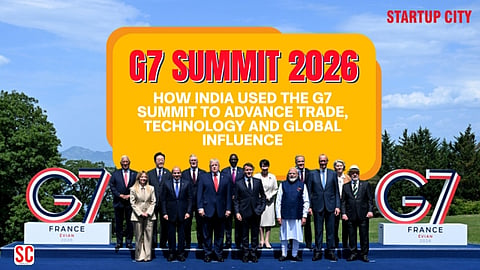

G7 Summit 2026
As leaders of the world's most advanced economies gathered in the French resort town of Évian for the G7 Summit 2026, India once again found itself at the centre of several of the most important global conversations despite not being a member of the group.
Over two days of engagements, Prime Minister Narendra Modi met leaders from the United States, Canada, the United Kingdom, Germany, France, the European Union, the United Arab Emirates and Ukraine. He participated in discussions on economic growth, artificial intelligence, connectivity, global development, energy security and geopolitical stability. More importantly, India emerged from the summit with progress on multiple trade agreements, renewed strategic partnerships and greater recognition of its role in shaping the global agenda.
The summit reflected a larger shift taking place in international affairs. Global powers increasingly view India not merely as a large market or a developing economy, but as an indispensable stakeholder in discussions involving trade, technology, supply chains, energy security and international governance.
The G7 comprises the United States, United Kingdom, Canada, France, Germany, Italy and Japan. Although India is not a member, it has become a regular participant because many of the world's biggest challenges cannot be effectively addressed without New Delhi's involvement.
India today is among the world's largest economies, one of the fastest-growing major markets and home to nearly one-sixth of humanity. It is also a leading voice for developing nations and a key player in the Indo-Pacific region.
This growing importance was visible throughout the summit. While the formal G7 members discussed major global issues, India was involved in conversations ranging from economic resilience and technology governance to energy security and geopolitical stability.
For New Delhi, the summit represented an opportunity to advance national interests while also presenting itself as a bridge between developed economies and the Global South.
Prime Minister Modi's most significant intervention came during the outreach session titled "Reviving a Balanced, Shared and Sustainable Economic Growth for All."
At a time when many countries are grappling with economic uncertainty, inflationary pressures and geopolitical disruptions, PM Modi argued that growth should not be measured solely through GDP figures or trade volumes.
Instead, he posed a more fundamental question: Who benefits from growth?
Drawing from India's own development experience, he highlighted the principle of "Sabka Saath, Sabka Vikas, Sabka Vishwas, Sabka Prayas" and presented India's growth journey as one centred on inclusion, scale and democratic participation.
He also linked India's domestic philosophy with its global approach, recalling the G20 theme of "One Earth, One Family, One Future" and arguing that sustainable global growth requires greater cooperation, trust and shared responsibility.
The Prime Minister warned that ongoing conflicts and supply-chain disruptions continue to place disproportionate burdens on developing nations and called for stronger international solidarity to support vulnerable economies.
One of the most ambitious proposals to emerge from India's participation was the suggestion to create the International Mobilisation Partnership for Accelerating Connectivity and Trade (IMPACT).
The initiative seeks to combine the investment capabilities of G7 countries, India's technological and human resource strengths and the ownership of developing countries to create new connectivity corridors across Africa, Latin America and Pacific Island nations.
The proposal builds upon the India-Middle East-Europe Economic Corridor (IMEC), a flagship connectivity project linking Asia, the Middle East and Europe.
India argued that future infrastructure and connectivity projects should be guided by principles of transparency, local ownership and long-term sustainability. Through IMPACT, New Delhi is seeking to position itself not just as a participant in global development projects but as one of their architects.
No bilateral engagement at the summit attracted more attention than the meeting between Prime Minister Modi and US President Donald Trump.
The encounter came after a challenging phase in India-US relations. Trade disputes, tariff disagreements, immigration concerns, differences over South Asia and the fallout from US military operations near Oman had created friction between the two countries.
Against that backdrop, the meeting served as an important reset.
Both leaders projected warmth and confidence, emphasising the importance of the strategic partnership and expressing optimism about future cooperation.
Trump described India as a close partner and praised PM Modi's negotiating skills, calling him a tough but effective leader. He also indicated his intention to visit India in the future and stated that the United States and India were closer than ever in their relationship.
The symbolism was important. At a time when many observers had questioned whether bilateral ties were facing headwinds, the summit offered a visible demonstration that both governments remain committed to strengthening the partnership.
Perhaps the most important outcome of the Modi-Trump meeting was the progress reported on trade negotiations.
Both sides acknowledged significant advances toward an interim Bilateral Trade Agreement. The announcement that US Trade Representative Jamieson Greer will visit India next week suggests that discussions have entered a crucial phase.
The proposed agreement is expected to address market access, tariffs, investment and commercial cooperation across multiple sectors.
For India, the agreement could provide improved access to the world's largest economy while strengthening supply-chain partnerships and attracting additional investment.
For the United States, India remains a critical economic partner in an increasingly competitive global environment.
While several details remain under negotiation, both governments indicated a strong desire to reach a balanced and mutually beneficial agreement as soon as possible.
One issue that figured prominently during the summit was the safety of Indian seafarers.
The matter gained urgency following the deaths of three Indian sailors in a US military strike targeting a vessel near Oman.
Prime Minister Modi raised the issue directly during discussions with President Trump and emphasised that hundreds of thousands of Indian seafarers contribute to global maritime commerce across critical shipping routes.
Their safety, he said, remains of utmost importance to India.
The conversation expanded into broader concerns regarding maritime security, freedom of navigation and uninterrupted commercial activity across international waterways.
The issue was closely linked to developments in West Asia and concerns over the Strait of Hormuz.
The conflict in West Asia and disruptions to maritime traffic through the Strait of Hormuz formed a recurring theme throughout the summit.
India imports the overwhelming majority of its crude oil requirements, making stability in the region vital for its economic interests.
Any prolonged disruption in the Strait of Hormuz can affect global energy prices, increase transportation costs and create uncertainty in international markets.
During both multilateral and bilateral discussions, India stressed the need to maintain freedom of navigation, secure maritime routes and ensure the safety of commercial shipping.
Prime Minister Modi welcomed efforts aimed at restoring peace in the region but also highlighted the economic consequences of instability for developing nations.
The issue underscored India's growing role as a stakeholder in global energy security discussions.
Another major outcome of the summit was the momentum gained by India's economic engagement with Europe.
Prime Minister Modi met European Commission President Ursula von der Leyen and European Council President António Costa, with both sides welcoming the successful conclusion of negotiations for the India-European Union Free Trade Agreement.
The agreement is expected to become one of the largest trade arrangements ever negotiated by India.
Leaders on both sides described it as a historic achievement and emphasised the need for its early signing and implementation.
The agreement is expected to unlock significant opportunities in trade, manufacturing, services, investment and supply-chain diversification.
For India, the deal represents a major step toward deeper integration with one of the world's largest economic blocs.
For Europe, it offers stronger engagement with one of the fastest-growing major economies and an increasingly important strategic partner.
The agreement is expected to be formally signed before the end of 2026.
India's meeting with UK Prime Minister Keir Starmer also produced a concrete outcome.
The two leaders confirmed that the India-UK Comprehensive Economic and Trade Agreement will be implemented from 15 July 2026.
The announcement transforms years of negotiations into a functioning economic partnership.
The agreement is expected to enhance trade flows, boost investment and create opportunities for businesses in both countries.
Prime Minister Modi highlighted the potential benefits for Indian farmers, workers, MSMEs, startups and innovators.
The implementation marks one of the most significant economic milestones in India-UK relations in recent years.
Among the most notable diplomatic developments at the summit was the rapid improvement in ties between India and Canada.
Only a short time ago, bilateral relations had reached one of their lowest points in decades following allegations made by former Canadian Prime Minister Justin Trudeau regarding the killing of Hardeep Singh Nijjar.
The dispute resulted in diplomatic expulsions and a significant deterioration in relations.
The meeting between Prime Minister Modi and Canadian Prime Minister Mark Carney reflected a dramatically different atmosphere.
Both leaders welcomed the positive momentum that has emerged since Carney's visit to India earlier this year.
The two countries agreed to begin negotiations on a General Security of Information Agreement (GSOIA), a framework that could facilitate deeper cooperation on defence and security matters, including the exchange of sensitive information.
The move is particularly significant because such agreements require a high degree of trust between governments.
The leaders also reviewed progress toward a Comprehensive Economic Partnership Agreement (CEPA) and reaffirmed their goal of concluding negotiations in 2026.
A successful outcome could pave the way for a PM Modi visit to Canada later this year.
Prime Minister Modi also used the summit to strengthen partnerships with other key countries.
In discussions with German Chancellor Friedrich Merz, the two leaders reviewed bilateral cooperation in trade, defence, green development, technology, education and mobility.
As India and Germany mark 75 years of diplomatic relations in 2026, both sides reaffirmed their commitment to expanding the strategic partnership.
The leaders welcomed the signing of a Defence Industrial Cooperation Roadmap and the operationalisation of a transit visa waiver for Indian nationals travelling through Germany.
PM Modi also met UAE President Sheikh Mohamed bin Zayed Al Nahyan, marking their third meeting this year.
The frequency of these engagements reflects the growing importance of India-UAE ties across energy, investment, technology and regional security.
Technology emerged as another important theme during the summit.
Prime Minister Modi participated in discussions on the safe and effective deployment of artificial intelligence alongside G7 leaders and senior executives from leading technology companies.
The conversations focused on balancing innovation with safety and ensuring that emerging technologies contribute to inclusive economic growth.
India's participation highlighted its ambition to become a major global hub for digital innovation, artificial intelligence and emerging technologies.
That focus will continue in Paris, where PM Modi is attending VivaTech 2026 with French President Emmanuel Macron.
India's largest-ever presence at the event reflects growing confidence in the country's startup ecosystem, digital economy and innovation capabilities.
The final phase of PM Modi's visit shifted attention toward France.
Traditionally, India-France relations have been associated with defence cooperation, space collaboration and strategic dialogue.
However, the current phase of the partnership increasingly emphasises technology, innovation, startups, artificial intelligence and future industries.
At VivaTech 2026, India is expected to showcase its growing digital ecosystem and attract investment into emerging sectors.
The visit also highlights the expanding scope of India-France cooperation beyond traditional areas into next-generation technologies and entrepreneurship.
Throughout the summit, India consistently positioned itself as a representative of developing nations.
Whether discussing economic resilience, connectivity, food security, energy challenges or financial reform, India's message focused on ensuring that developing countries are not excluded from global decision-making.
Prime Minister Modi called for stronger support mechanisms within international financial institutions and argued that future global growth models must be more inclusive and equitable.
The approach reflects India's broader diplomatic strategy of acting as a bridge between advanced economies and emerging nations.
The G7 Summit 2026 demonstrated how significantly India's international profile has evolved.
The country entered the summit as a guest nation but participated as a central actor in discussions on trade, technology, connectivity, energy security and global governance.
India secured progress on trade negotiations with the United States, moved closer to implementing agreements with the United Kingdom and the European Union, advanced the repair of relations with Canada, strengthened ties with Germany and the UAE, and expanded cooperation with France in innovation and technology.
At the same time, it continued to advocate for the interests of the Global South while presenting new ideas for connectivity, development and economic cooperation.
The summit reinforced an increasingly accepted reality in international affairs: major decisions about the future of the global economy, technology ecosystems, supply chains and strategic partnerships are becoming difficult to imagine without India's participation.
In Évian, India was not merely present at the table. It was actively helping shape the agenda.

